
How to use the pile capacity calculator
A single pile in layered soil: what each input means, how the shaft and base add up, and which number to carry to the pile cap.
1. What the calculator does
The pile capacity calculator works out how much load a single pile can carry in the ground. From the soil layers it adds up the shaft friction along the pile and the end bearing at the toe, applies the factors of the design basis, and gives the working and design resistances in compression and tension. It also checks the pile shaft as a concrete section for the ULS loads.
The design basis is SANS 10160-5 Table B.2 or EN 1997-1 R4 (DA2); the shaft is checked to SANS 10100-1. The page badge says it plainly: the α and β coefficients are practice values you can see on the calc sheet.

2. The inputs, group by group
| Input | What it means | Typical value |
|---|---|---|
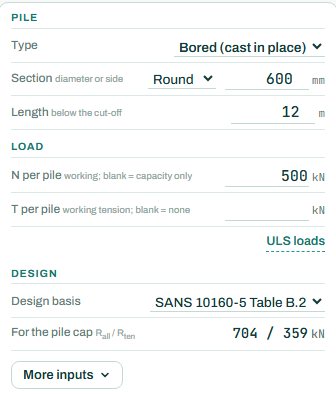
| Pile | Type (bored cast in place, CFA, driven precast), round or square, diameter or side, and the length below the cut-off. | bored, ø600, 12 m |
| Load | Working N per pile and working tension T; leave blank for the capacity only. ULS loads for the shaft check. | N 500 kN |
| Design | The design basis. | SANS 10160-5 Table B.2 |
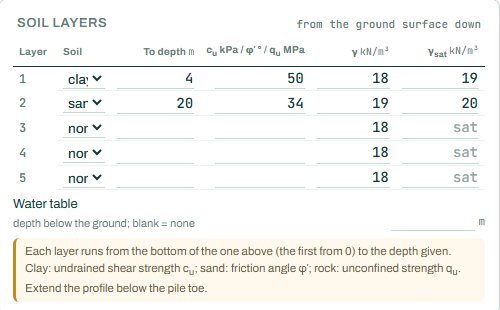
| Soil layers | Up to five layers from the ground surface down: soil type, the depth to the bottom of the layer, the strength (cu for clay, φ′ for sand, qu for rock), and the unit weights; plus the water table. | clay to 4 m (cu 50), sand to 20 m (φ′ 34°) |
3. How to read the result
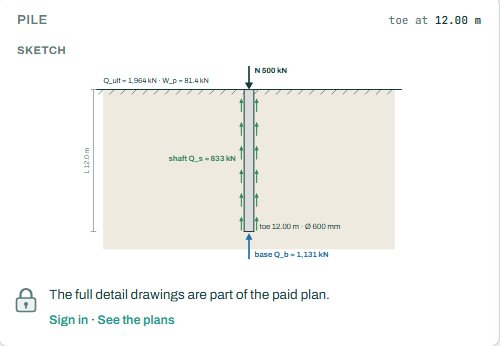
The sketch draws the pile in the soil with the shaft friction and the base resistance. The capacity card gives the shaft, base and ultimate resistance, the pile weight, the working compression and tension, the ULS design resistances, the group efficiency and the shaft check.
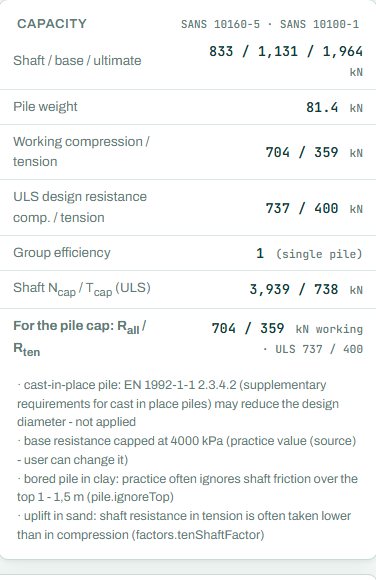
The last line is the one to take to the pile cap calculator: Rall / Rten, the working compression and tension per pile. Read the notes under it: they say which practice values were used (for example the cap on base resistance, and whether the top of the shaft in clay is ignored) and where you can change them.
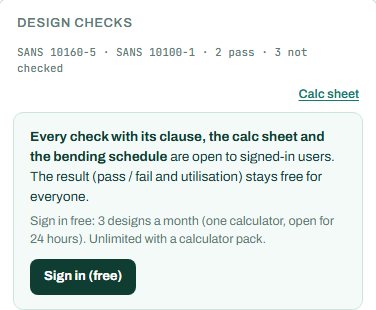
The badge names the governing check. The checks card counts the passes and the NOT CHECKED items; NOT CHECKED is not a pass, so read which items they are once signed in.
4. Calc sheet
The result (pass / fail and utilisation) stays free for everyone. Every check with its clause, the calc sheet and the bending schedule are open to signed-in users. Sign in free: 3 designs a month (one calculator, open for 24 hours). Unlimited with a calculator pack.
The full detail drawings are part of the paid plan.
5. A 2-minute walk-through
- Open the calculator: a bored ø600 pile, 12 m long, in 4 m of clay over sand, with N 500 kN working.
- Read the badge: PASS 71 %; Rall is 704 kN.
- Lengthen the pile to 15 m and see the shaft friction grow.
- Add a water table at 2 m and see the sand friction drop.
- Change the type to driven and compare.
6. Common mistakes
- A soil profile that stops at the toe. The base resistance depends on the soil below the toe; extend the profile.
- Working loads where ULS loads are asked for, or the other way round. N and T per pile are working loads; the shaft check uses the ULS loads.
- One pile’s capacity for a close group. Closely spaced piles carry less each; check the group efficiency.
- Practice values as site data. The α and β values are typical; a pile test or the geotechnical engineer’s values come first.
- Ignoring the water table. Water lowers the effective stress and the friction in sand.
7. Where it fits
Rall and Rten go to the pile cap calculator as the pile capacity.
8. Learn more
- Foundations 1, lesson 5: pile capacity
- Worked example: pile capacity to SANS 10160-5
- Guide: the pile cap calculator
Open the pile capacity calculator
A guide to using the calculator, not a design. Check every value against the current code and your own project, and have the design checked and signed by a registered professional engineer.
Be first to use STATIX 3D and STATIX 2D.
Leave your email and we will tell you when each part is ready for testing. One confirmation now, one message then. A short monthly update only if you tick the box.