
How to use the pile cap calculator
A column on a group of piles: what each input means, how to read the pile reactions and the strut-and-tie model, and why the anchorage so often governs.
1. What the calculator does
The pile cap calculator designs a reinforced concrete cap that carries a column onto a group of piles. It shares the column load and moments between the piles, checks each pile reaction against the pile capacity, and designs the cap: the tie bars between the piles, shear, punching at the column and at the piles, and the anchorage of the tie bars past the piles.
The code routes are SANS 10100, BS 8110, Eurocode 2 (EN 1992-1-1) and SANS 51992-1-1 (SA Eurocode, 2023 draft annex). The page badge says which method: the truss method to BS 8110 cl. 3.11.4 on SANS and BS, strut-and-tie per EN 1992-1-1 cl. 6.5 and 9.8.1 on Eurocode 2.

2. The inputs, group by group
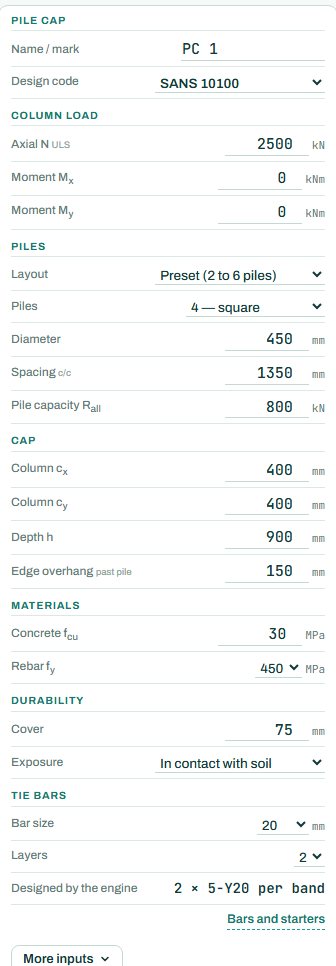
| Input | What it means | Typical value |
|---|---|---|
| Column load | Factored axial N and moments Mx, My. The SLS load under More inputs lets the pile reactions be checked at SLS. | N 2500 kN ULS |
| Piles | Layout (preset 2 to 6 piles, or a general grid or coordinates), number, diameter, spacing and the pile capacity Rall. | 4 square, ø450, spacing 1350, 800 kN |
| Cap | Column size, cap depth and the overhang past the piles. | 400 × 400, h 900, overhang 150 |
| Materials | Concrete fcu and rebar fy. | 30 MPa, 450 MPa |
| Durability | Cover and exposure. | 75 mm, in contact with soil |
| Tie bars | Bar size and layers; the engine designs the bars per band over the piles. Bars and starters lets you set them. | Y20, 2 layers |
3. How to read the result
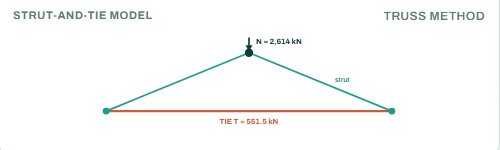
The plan draws the cap with each pile and its reaction, the column and the tie bars per band. The section shows the cap depth and the piles below. The strut-and-tie model shows the load path: struts from the column down to the piles and the tie between the pile heads, with its force.
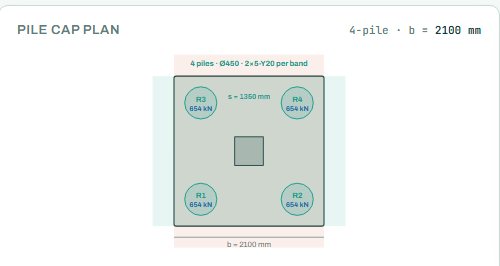
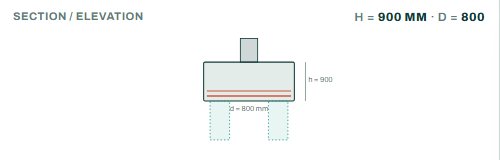
The badge names the governing check; here the anchorage of the tie bars past the piles (bobbed ends). Pile caps are often governed by the anchorage, the punching at a corner pile or the shear, more than by the tie area. Anything the engine could not run shows as NOT CHECKED.
Look at the pile reaction check: without an SLS load, the page compares the ULS reaction with Rall and says so with “(ULS)”, which is on the safe side. Give the SLS axial load to check the reaction at working load.
4. Calc sheet, drawing and schedule
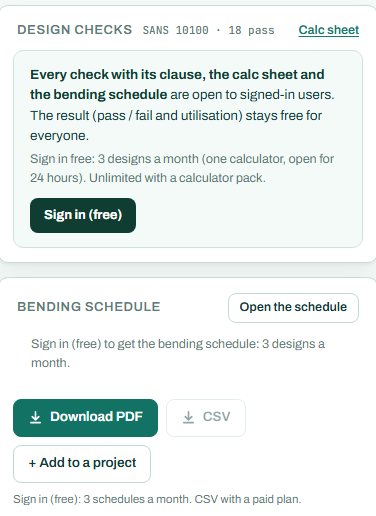
The result (pass / fail and utilisation) stays free for everyone. Every check with its clause, the calc sheet and the bending schedule are open to signed-in users. Sign in free: 3 designs a month (one calculator, open for 24 hours). Unlimited with a calculator pack.
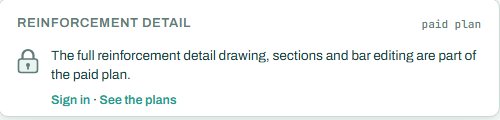
The bending schedule card reads: “Sign in (free): 3 schedules a month. CSV with a paid plan.” The full reinforcement detail drawing is part of the paid plan.
5. A 2-minute walk-through
- Open the calculator: a 400 × 400 column with N 2500 kN on four ø450 piles at 1350 mm, cap 900 mm deep.
- Read the pile reactions (654 kN each) and the tie force (551.5 kN).
- Add Mx 300 kNm and see the reactions split between the two rows of piles.
- Reduce the depth to 750 mm: the tie force goes up and the shear checks get harder.
- Try three piles in a triangle for a lighter column.
6. Common mistakes
- Allowable pile capacity against a ULS reaction without knowing it. Give the SLS load, or accept the conservative check.
- Short overhang. The tie bars need room to anchor past the pile; a small overhang makes the anchorage govern.
- Pile spacing too close. Spacing below about three diameters cuts the pile group capacity; check it with the pile capacity calculator.
- Forgetting the cap self-weight. The engine includes it by default (More inputs); leave it on.
8. Learn more
- Foundations 1, lesson 6: pile caps
- Worked example: pile cap to SANS 10100
- Guide: the pile capacity calculator
Open the pile cap calculator
A guide to using the calculator, not a design. Check every value against the current code and your own project, and have the design checked and signed by a registered professional engineer.
Be first to use STATIX 3D and STATIX 2D.
Leave your email and we will tell you when each part is ready for testing. One confirmation now, one message then. A short monthly update only if you tick the box.