
How to use the cold-formed member calculator
A light-gauge channel or Zed under axial load and bending: what each input means, the three buckling modes, and how to read the section card.
1. What the calculator does
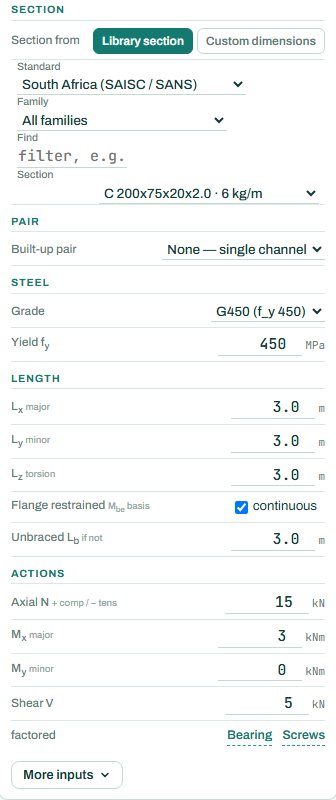
The cold-formed steel member calculator checks a light-gauge member under axial load, bending about both axes and shear: a lipped channel or a lipped Zed, single or built up from two (back to back, or toe to toe as a box). Cold-formed sections are thin, so they buckle locally, distortionally and overall; the engine checks all three with the Direct Strength Method.
The code route is SANS 10162-2, which is the same text as AS/NZS 4600: the Direct Strength Method of Section 7, with distortional buckling from Appendix D, shared with the purlin calculator. The page says plainly that the compression branch of distortional buckling is a documented “verify” item, pending an independent cross-check (see the calc sheet).

2. The inputs, group by group
| Input | What it means | Typical value |
|---|---|---|
| Section | A library section (standard, family, size) or custom dimensions. | C 200×75×20×2.0 |
| Pair | Single channel, or a built-up pair back to back or toe to toe. | single channel |
| Steel | Grade and yield strength. | G450, fy 450 |
| Length | Effective lengths about the major and minor axes and for torsion; whether a flange is restrained (continuous) or the unbraced length. | 3.0 m each |
| Actions | Factored axial N (+ compression, − tension), Mx, My and shear V. Bearing and screws open their own checks. | N 15 kN, Mx 3 kNm, V 5 kN |
3. How to read the result
The section card gives the area, the second moments of area, the radii of gyration, the shear centre (offset from the web in a channel, so a load through the web also twists it), the warping and torsion constants, and whether the section is within the limits where the Direct Strength Method is prequalified.
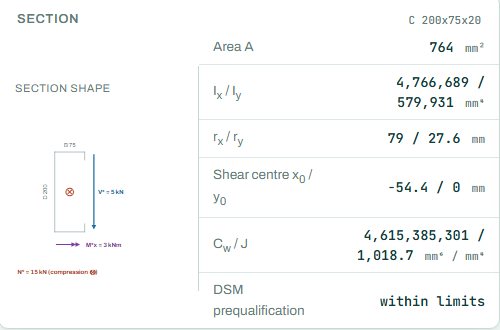
The badge names the governing check; here axial and bending together at 48 %. If DSM prequalification is outside the limits, the method does not apply as written: treat the result with care and check by another route. Anything the engine could not run shows as NOT CHECKED.
4. Calc sheet
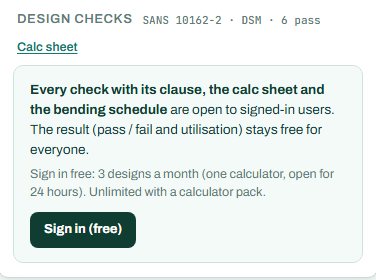
The result (pass / fail and utilisation) stays free for everyone. Every check with its clause, the calc sheet and the bending schedule are open to signed-in users. Sign in free: 3 designs a month (one calculator, open for 24 hours). Unlimited with a calculator pack.
The full detail drawings are part of the paid plan. The calc sheet sets out the local, distortional and global buckling values for compression and bending, with the interaction.


5. A 2-minute walk-through
- Open the calculator: a C 200×75×20×2.0 in G450, 3 m effective lengths, N 15 kN, Mx 3 kNm, V 5 kN.
- Read the badge: PASS 48 %, axial and bending.
- Untick the continuous flange restraint and see the bending capacity drop.
- Make it a back-to-back pair and see the compression capacity rise.
- Try 1.6 mm and find where it fails.
6. Common mistakes
- Hot-rolled thinking. A thin section can fail by local or distortional buckling well below its yield; that is why DSM checks three modes.
- Load through the web of a single channel without thinking of the twist; the shear centre is outside the section.
- Continuous restraint that is not there. Only fastened sheeting restrains the flange.
- Ignoring the connections. Bearing at the supports and the screws often govern light members; open those checks.
- A built-up pair without enough fasteners. Two channels act together only if they are screwed or bolted along their length; check the spacing of the fasteners.
7. Where it fits
For roof purlins and wall girts under distributed load, use the cold-formed purlin calculator, which shares the same engine. Use this page for light-gauge members with axial load: struts, truss chords, studs, and bracing members of light steel frames. Take the factored forces from the frame or truss analysis, and check the screws and the bearing at each end too.
8. Learn more
- Steel Design 2, lesson 3: cold-formed sections and lesson 2: purlins and girts
- Guide: the cold-formed purlin calculator
Open the cold-formed member calculator
A guide to using the calculator, not a design. Check every value against the current code and your own project, and have the design checked and signed by a registered professional engineer.
Be first to use STATIX 3D and STATIX 2D.
Leave your email and we will tell you when each part is ready for testing. One confirmation now, one message then. A short monthly update only if you tick the box.