
Wind load to SANS 10160-3
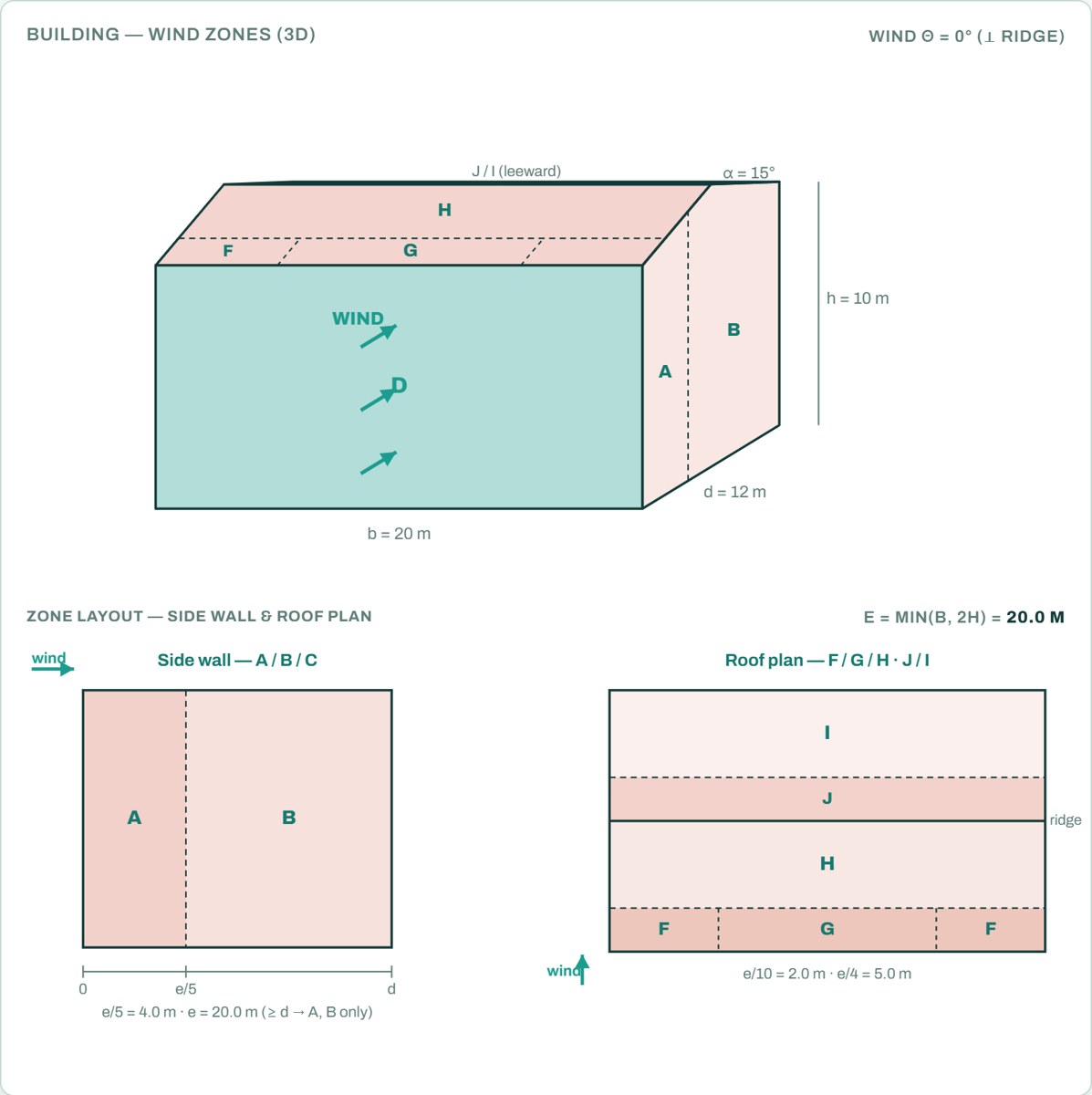
Peak wind pressure, wall and duopitch roof pressures for a 20 × 12 m building, 10 m high, step by step. The numbers come from the free STATIX wind load calculator and were checked by hand.
1. The problem
| Input | Value |
|---|---|
| Building | 20 m long (b) × 12 m wide (d) × 10 m high (h), duopitch roof at 15° |
| Basic wind speed | vb = 32 m/s (see the warning below) |
| Terrain | Category C (suburban) |
| Site altitude | 0 m (air density 1.20 kg/m³) |
| Internal pressure | Cpi = +0.2 / −0.3 |
Check the wind speed first. 32 m/s is the lowest basic wind speed in SANS 10160-3 Annex A. Most of South Africa is 36 or 40 m/s. Pressure grows with the square of the speed, so a 40 m/s site designed at 32 m/s is under-designed by 56%. Look up your municipality in Table A.1.
2. Basic velocity pressure (cl. 7.4)
3. Peak velocity pressure at 10 m (cl. 7.3, Table 1)
The SANS map already gives a 3-second gust speed, so there is no gust factor to add.
4. Walls (cl. 8.3.2, Table 6)
5. Duopitch roof at 15° (cl. 8.3.5, Table 10)
6. Cladding and fixings
For small loaded areas (1 m² or less: sheeting, fixings, purlin connections) use the local coefficients Cpe,1. They are much higher at corners and edges:
7. Result
| Item | Net pressure |
|---|---|
| Peak velocity pressure qp at 10 m | 0.445 kPa |
| Windward wall | +0.48 kPa |
| Wall edge zone A | −0.62 kPa |
| Roof uplift, zone J | −0.53 kPa |
| Roof corner F, cladding (≤ 1 m²) | −0.98 kPa |
Repeat for wind on the gable (θ = 90°) and for the other internal pressure. The worst of all cases governs each element.
Open the free wind load calculator
A worked example for learning, not a design. Check every value against the current code and your own project, and have the design checked and signed by a registered professional engineer.
Be first to use STATIX 3D and STATIX 2D.
Leave your email and we will tell you when each part is ready for testing. One confirmation now, one message then. A short monthly update only if you tick the box.