
Punching shear in flat slabs to SANS 10100
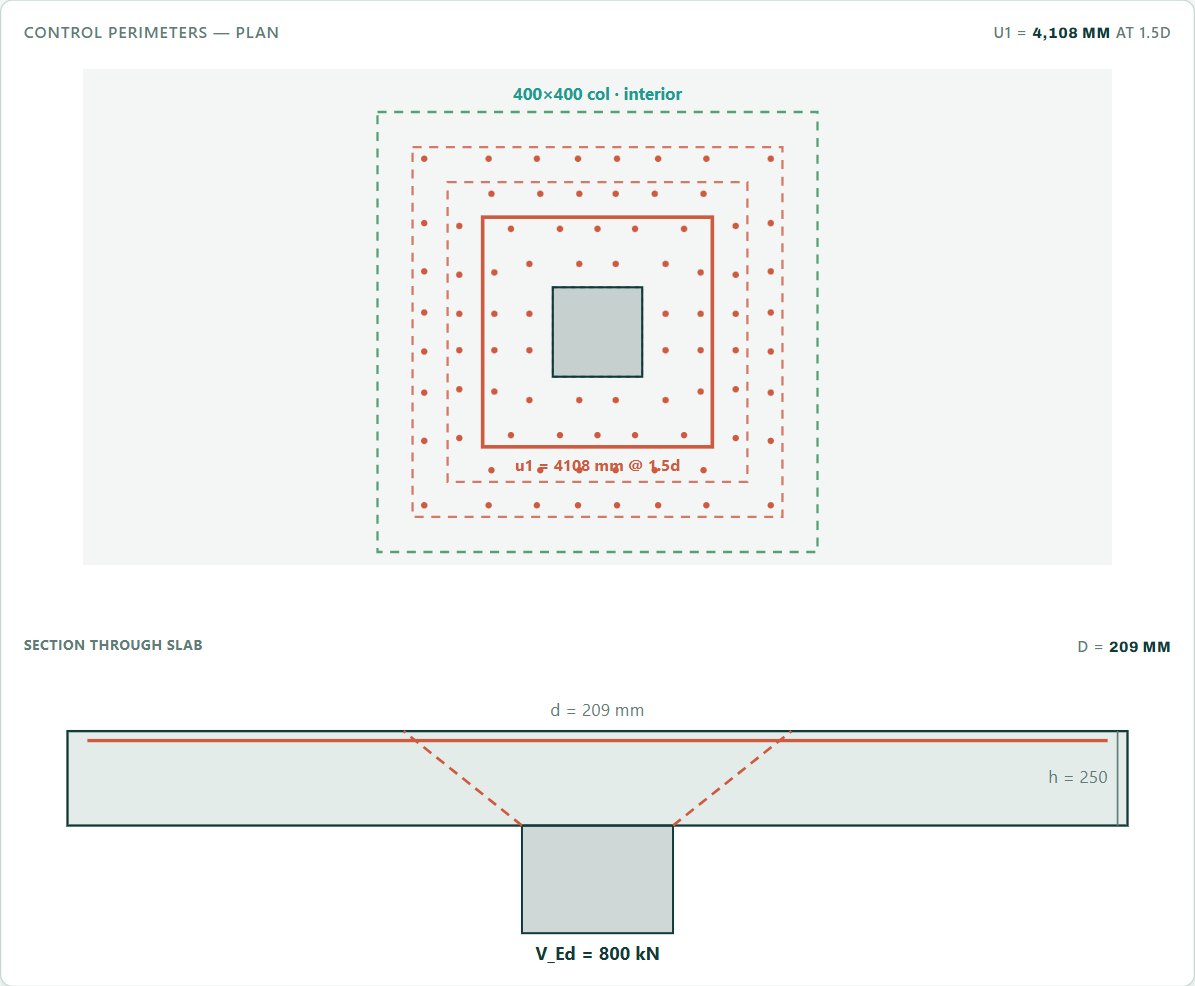
A 400 mm square interior column in a 250 mm flat slab: effective shear, the column-face check, vc, control perimeters at 0.75d steps and shear links. Every number below comes from the free STATIX punching shear calculator and was checked by hand.
1. The problem
| Input | Value |
|---|---|
| Column | 400 × 400 mm, interior |
| Slab | 250 mm flat slab, no drop panel, cover 25 mm |
| Top steel over the column | Y16 at 125 mm both ways |
| Design shear from the slab into the column | Vt = 800 kN (ultimate), no unbalanced moment |
| Materials | fcu = 30 MPa, fyv = 450 MPa for the links |
2. Effective depth and steel ratio
The two layers of top steel sit at different depths. SANS 10100 cl. 4.4.5.2.1 uses the average depth of the steel that crosses the perimeter.
3. Concrete shear stress vc (cl. 4.3.4.1, eq. 2)
SANS uses 0.75 with γm = 1.40. BS 8110 uses 0.79 with 1.25, which gives a higher vc. Do not mix the two. fcu is capped at 40 MPa and 100As/bd at 3.
4. Effective shear with moment transfer (cl. 4.6.2.2)
A column in a flat slab also takes some moment from the slab, which makes the shear uneven around it. For an interior column in a braced building with spans that differ by no more than 25%, SANS lets you allow for this with a factor of 1.15.
In other cases use eq. (8): Veff = Vt(1 + 1.5Mt/(Vtx)), but not less than 1.15Vt, where x is the side of the perimeter parallel to the bending axis. Corner columns, and edge columns bent at right angles to the edge, use 1.25Vt. Edge columns bent parallel to the edge use 1.40Vt (cl. 4.6.2.3).
5. Column face
This is the concrete crushing next to the column. No links can fix it: if it fails, the slab, a drop panel or the column must get bigger.
The calculator uses the general limit for a concentrated load on a slab, 0.75√fcu. For the face of a column in a flat slab, cl. 4.6.2.4 allows the lesser of 0.8√fcu and 5.0 MPa, here 4.38 MPa. The calculator's check is on the safe side.
6. Control perimeters (cl. 4.4.5.2)
The first perimeter is the rectangle 1.5d from the column face. If v there is more than vc, check further perimeters at 0.75d steps until one passes. For a rectangle around a rectangular column the length is u = 2(cx + cy) + 8a, where a is the distance from the face.
| Perimeter | u (mm) | v (MPa) | v / vc |
|---|---|---|---|
| 1 at 1.50d = 314 mm | 4,108 | 1.072 | 1.75: links needed |
| 2 at 2.25d = 470 mm | 5,362 | 0.821 | 1.34: links needed |
| 3 at 3.00d = 627 mm | 6,616 | 0.665 | 1.08: links needed |
| 4 at 3.75d = 784 mm | 7,870 | 0.559 | 0.91: OK, no links |
All three failing perimeters are below 2vc = 1.23 MPa, so links are allowed. The slab is 250 mm thick, over the 200 mm that eq. 7(a) and 7(b) require.
Without links, this slab would carry Vt = 0.614 × 4,108 × 209 / 1.15 = 458 kN on this column. The 800 kN here is well above that.
7. Shear links (cl. 4.4.5.2.6)
Which formula applies depends on how far v is above vc:
Each perimeter's steel goes in its failure zone, the band between it and the line 1.5d inside it. The calculator spreads it over at least two rings of links in that zone. Links already in the zone from an earlier perimeter count.
8. Link layout
The calculator puts the full ΣAsv of the worst perimeter in every ring. That is more than each zone needs: each zone gets two rings, so 3,142 mm² against 1,496 mm² at most. You can reduce the legs once you have checked each zone. Anchor every leg around the top steel.
9. Result
| Check | Result |
|---|---|
| Column face | 2.75 ≤ 4.11 MPa |
| First perimeter (1.5d) | 1.072 > vc 0.614 MPa: links needed |
| Links needed out to | perimeter 3 at 3.0d; perimeter 4 at 3.75d passes (0.559 MPa) |
| Link steel | 1,496 / 1,145 / 1,413 mm² on perimeters 1 / 2 / 3 |
| Layout | 4 rings of 20 Y10 legs, first at 105 mm, then every 157 mm |
Two rules the calculator applies that matter for other inputs. In flat slabs between 150 and 200 mm thick, SANS cl. 4.6.2.1 reduces the stress in the links in a straight line from the full value at 200 mm to zero at 150 mm, and cl. 4.6.1.5 sets 150 mm as the thinnest slab that may have shear reinforcement. So a thinner slab that needs links fails the check. And fyv is never taken above 450 MPa, even if the link steel is stronger.
Open the free punching shear calculator
A worked example for learning, not a design. Check every value against the current code and your own project, and have the design checked and signed by a registered professional engineer.
Be first to use STATIX 3D and STATIX 2D.
Leave your email and we will tell you when each part is ready for testing. One confirmation now, one message then. A short monthly update only if you tick the box.