
How to use the corbel calculator
A short bracket on a column, designed as a strut and a tie: what each input means, how to read av/d and the tie force, and why the anchorage so often governs.
1. What the calculator does
The corbel calculator designs a short reinforced concrete bracket that sticks out of a column or wall to carry a beam or a crane rail: a single corbel, a double-sided corbel or a continuous nib. A corbel is too short to act as a beam, so it is designed as a strut and tie: a concrete strut from the load down into the column and a steel tie along the top. The engine checks the tie, the strut, the shear with the enhancement for a short shear span, the bearing under the pad, the horizontal links and the anchorage of the main bars.
The code routes are SANS 10100-1, Eurocode 2 (EN 1992-1-1) and SANS 51992-1-1 (SA Eurocode, 2023 draft annex). The badge names the clauses: SANS 10100-1 cl. 6.2.4.2 corbels, cl. 4.3.4.2 enhanced shear, cl. 6.2.4.4 bearing; EN 1992-1-1 Annex J.3 and 6.5.

2. The inputs, group by group
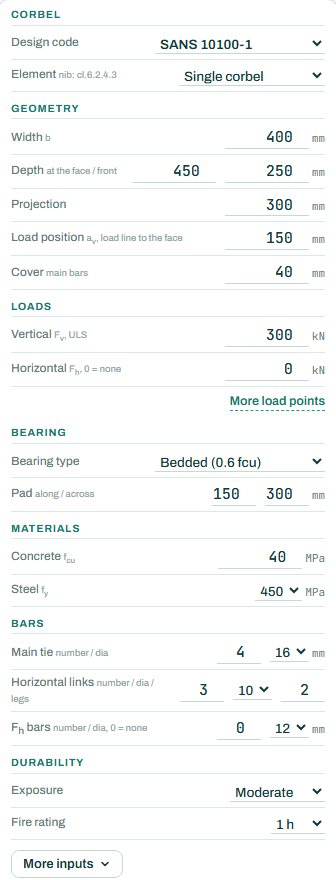
| Input | What it means | Typical value |
|---|---|---|
| Corbel | Design code and the element: single corbel, double-sided corbel or continuous nib. | single corbel |
| Geometry | Width, depth at the column face and at the front, projection, the load position av from the face, and cover. | 400 wide, 450 / 250 deep, 300 projection, av 150 |
| Loads | Factored vertical load Fv and horizontal load Fh (from shrinkage or braking). | Fv 300 kN, Fh 0 |
| Bearing | Dry, bedded or a cast-in plate, and the pad size. | bedded, 150 × 300 |
| Materials | Concrete fcu and steel fy. | 40 MPa, 450 MPa |
| Bars | Main tie bars, horizontal links (number, size, legs) and extra bars for Fh. | 4Y16, 3 × Y10 links |
| Durability | Exposure and fire rating. | moderate, 1 h |
3. How to read the result
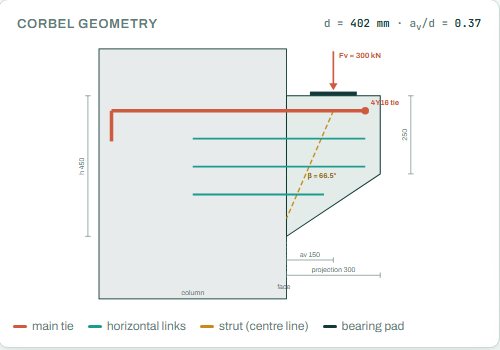
The geometry sketch draws the corbel to scale with the main tie hooked into the column, the horizontal links, the strut and the bearing pad. The header gives d and av/d: a corbel has av/d below 1 (here 0.37); above that it is a cantilever beam.
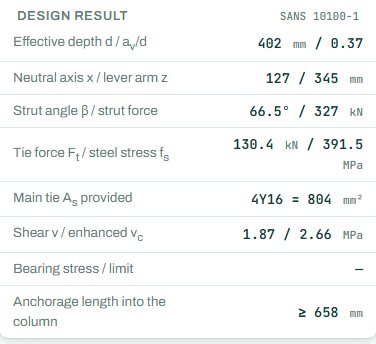
The badge names the governing check; here the anchorage of the main bars into the column at 96 %. In corbels the anchorage at both ends of the tie often governs: at the front (a welded cross bar or a loop, under More inputs) and into the column. Anything the engine could not run shows as NOT CHECKED.
4. Calc sheet, drawing and schedule
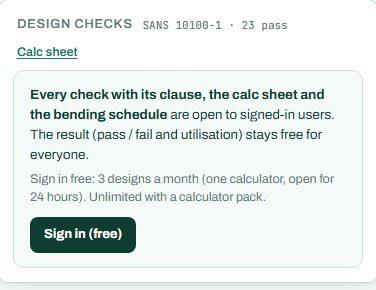
The result (pass / fail and utilisation) stays free for everyone. Every check with its clause, the calc sheet and the bending schedule are open to signed-in users. Sign in free: 3 designs a month (one calculator, open for 24 hours). Unlimited with a calculator pack.
The bending schedule card reads: “Sign in (free): 3 schedules a month. CSV with a paid plan.” The full reinforcement detail drawing is part of the paid plan.
5. A 2-minute walk-through
- Open the calculator: a 400 mm wide corbel, 450 deep at the face, 300 projection, Fv 300 kN at 150 mm from the face.
- Read the badge: PASS 96 %, main bar anchorage.
- Move the load out to 250 mm and see av/d, the tie force and the shear change.
- Add Fh = 60 kN (20 % of Fv) and see the tie grow.
- Switch to a continuous nib for a beam bearing along a wall.
6. Common mistakes
- No horizontal force. Shrinkage and creep of the beam on top pull on the corbel; many designers use at least 20 % of Fv unless the bearing slides.
- Load too close to the front. The bearing pad must stop short of the front edge so the bearing does not spall the corner.
- A straight tie bar. The main bars need a welded cross bar or a loop at the front, and full anchorage into the column.
- Characteristic loads. Fv is a factored ULS load.
8. Learn more
Open the corbel calculator
A guide to using the calculator, not a design. Check every value against the current code and your own project, and have the design checked and signed by a registered professional engineer.
Be first to use STATIX 3D and STATIX 2D.
Leave your email and we will tell you when each part is ready for testing. One confirmation now, one message then. A short monthly update only if you tick the box.